
You may also be interested in our companion article: Hiding in plain sight: what chargeback data reveals about residential proxies.
Interest in residential proxy detection has grown exponentially in the past year, with businesses paying more attention to proxy-based threats that operate out of clean-looking residential networks.
Residential proxies route traffic through real consumer IP addresses, sourced either from devices compromised by malware, from users who opt in to share bandwidth through an app SDK, or from IP blocks leased directly from ISPs. They have become the widening frontier of digital risk for governments and businesses worldwide. What used to be a niche concern for security teams has now reached the general public with the FBI issuing an alert to consumers, warning them that their own devices could be unwitting tools for criminal activity. Described as a “back door into home networks” in a recent article from The Wall Street Journal’s Robert McMillan, these proxy networks aren’t just being used to download pirated movies; they’re also being used for state-backed corporate espionage and other serious crimes.
This creates a difficult problem for businesses: How do you detect residential proxy traffic and defend against it without disrupting legitimate user traffic?
Understanding the residential proxy threat
Despite the “breaking news” framing of recent reporting on the issue, residential proxies have existed for many years. Residential proxies are proxy networks that run on consumer IP addresses used by regular people to browse the internet, whether those addresses come from devices compromised without the owner’s knowledge, from opt-in bandwidth-sharing apps, or from blocks leased directly from ISPs.
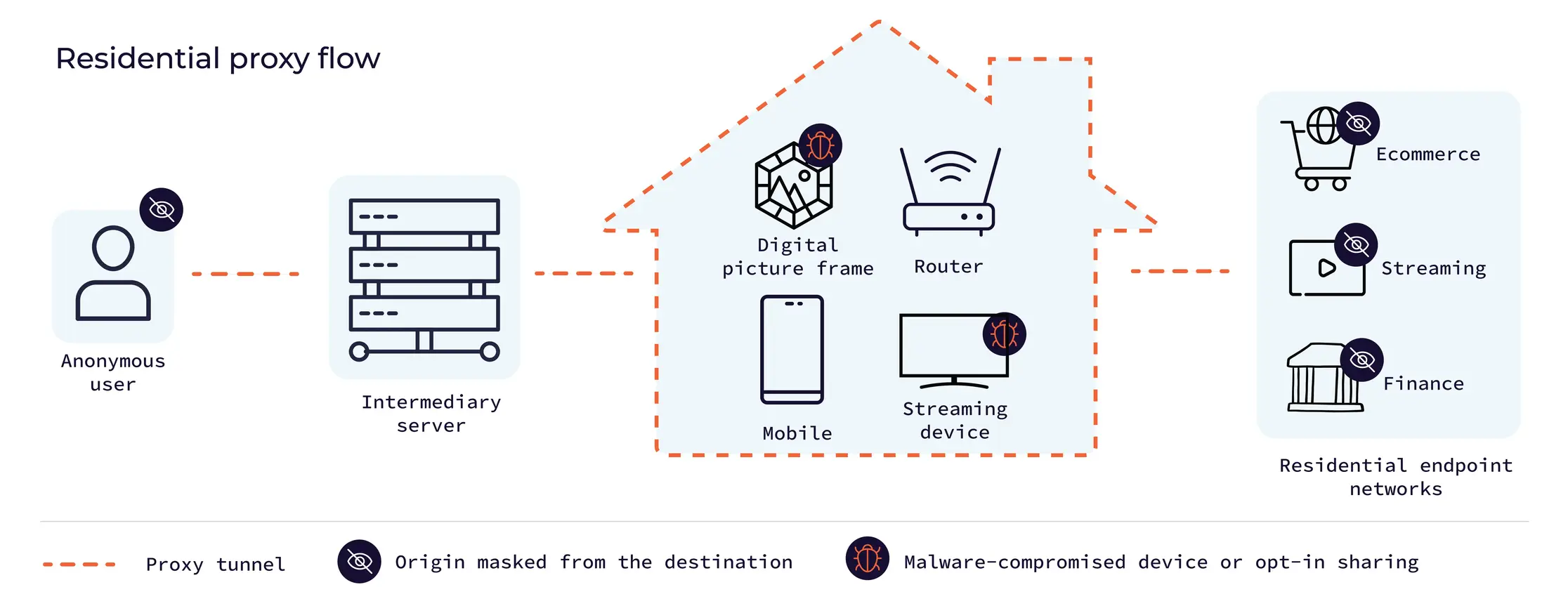
The Wall Street Journal reported a story that’s all too familiar to those of us in the industry. A regular consumer buys a device, for example “video-streaming systems, phones, cameras and […] digital picture frames” that come with malware pre-installed. Or they download an app to a smart device, not realizing it quietly turns their home network into a proxy service that gets used by countless others to bypass regulations, avoid content protections, or commit fraud.
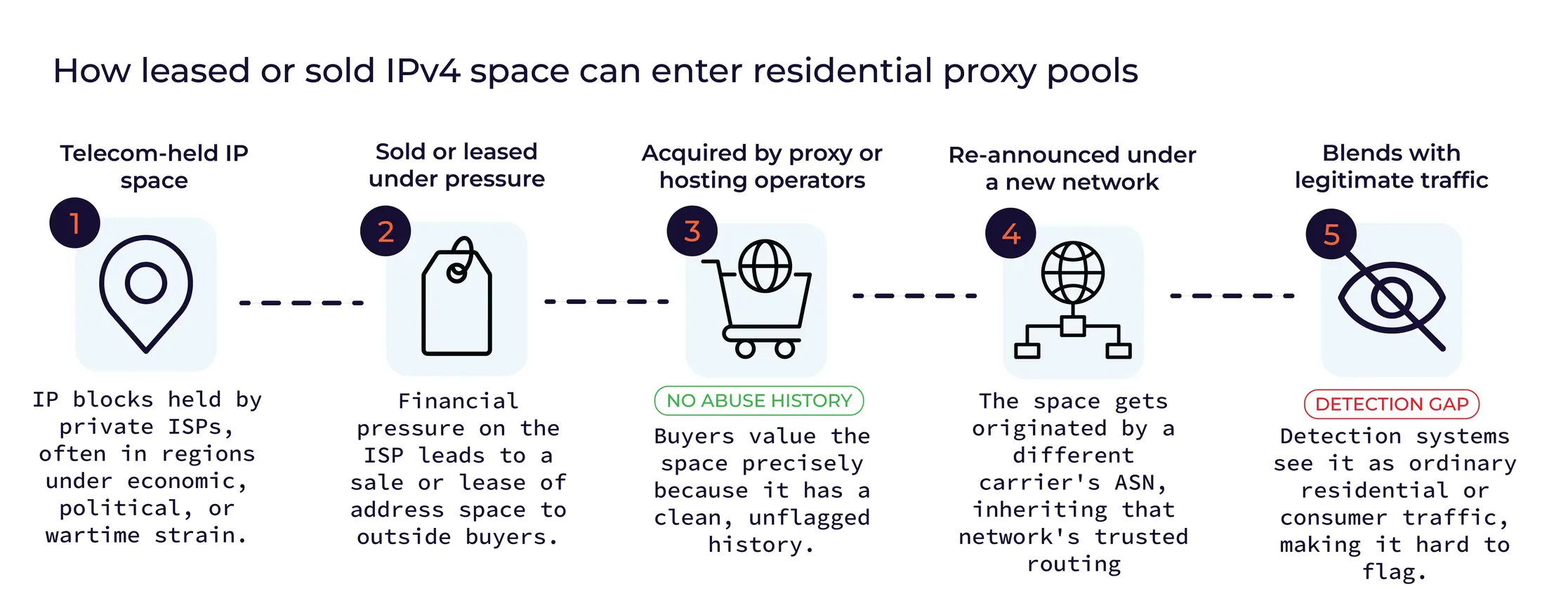
Proxy providers have known for a long time that proxied residential IP addresses are harder to detect and often have a clean reputation. This makes them valuable, so certain proxy providers go to great lengths to “launder” these addresses to avoid detection. When the North American Network Operators Group (NANOG) convened in San Francisco in February 2026, Doug Madory of Kentik presented research showing how proxy providers buy IP addresses from war-torn, cash-strapped nations, then bring those IPs into US residential networks through “bring your own IP programs”. An IP with a clean history, one recently used to provide internet service to Ukrainian citizens for example, can be leased or sold and brought into an American residential network where it looks completely legitimate.
While residential proxy providers work hard to hide what they’re doing, security researchers and organizations committed to digital safety are working just as hard to stop them. In July 2026, KrebsonSecurity reported that the FBI, acknowledging the assistance of industry partners Google, Lumen, Shadowserver, and others, took down infrastructure behind NetNut, a “sprawling residential proxy network” linked to the Israeli firm Alarum Technologies. This is a constant back-and-forth between proxy providers and the people that keep the internet safe and usable, with businesses caught in-between.
Risk profile in MaxMind’s global fraud detection network
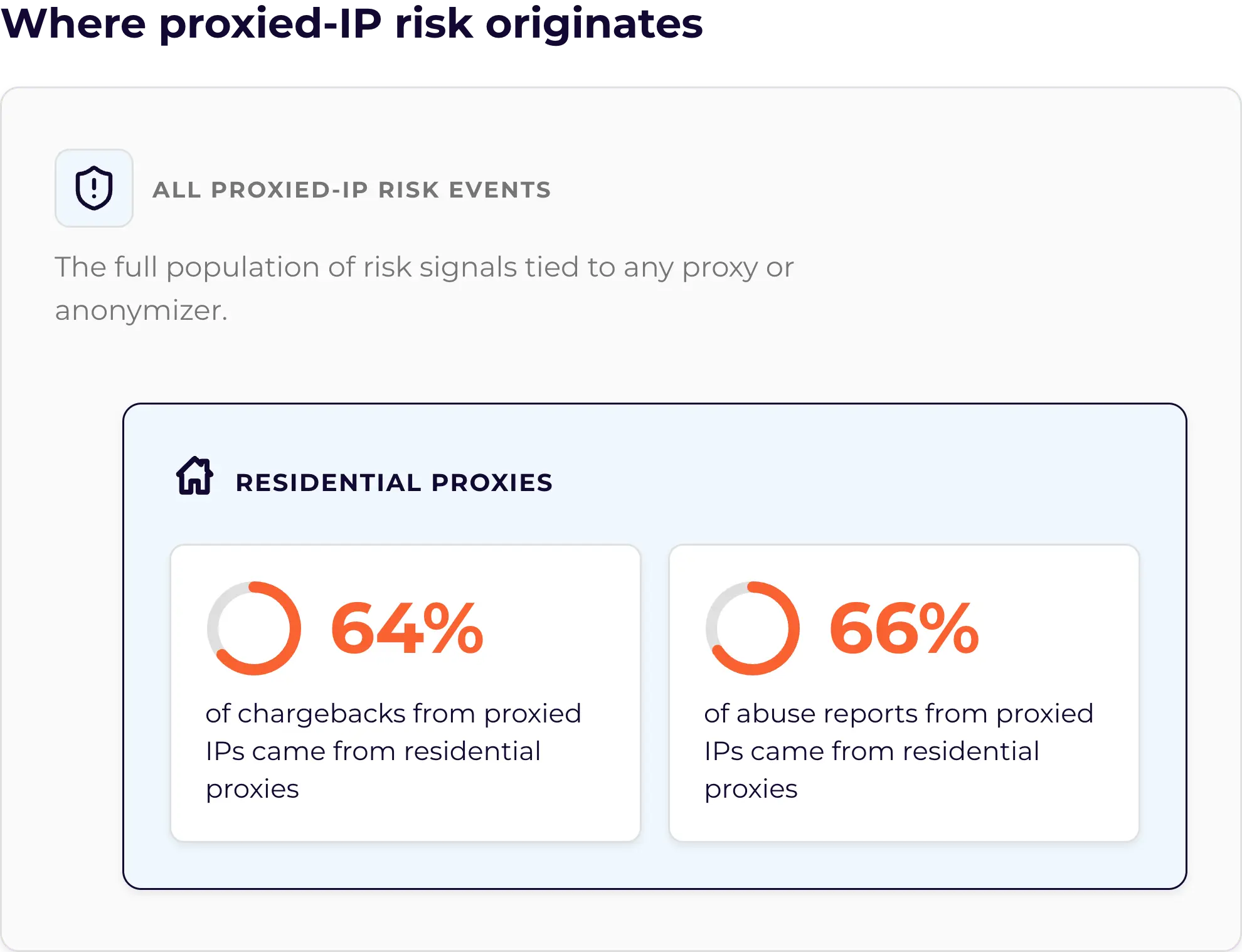
At MaxMind, we have observed residential proxy usage in fraud attacks for a long time, even before direct-probing data was incorporated into our solutions. To understand how big this problem really is, we analyzed risky events observed across the minFraud network, which powers our real-time fraud risk scoring. Unsurprisingly, residential proxies represent a significant proportion of problematic traffic, which we expand on in a related blog article.
The challenge: Shared infrastructure and false positives
Older blocking methods rely heavily on flagging hosting infrastructure and that approach falls short here. It works reasonably well for VPN detection, though even then, overly aggressive blocking can incorrectly flag legitimate businesses that share network space with VPN providers. For residential proxies, this approach doesn’t work at all.
Shared infrastructure makes VPN detection hard—and it makes residential proxy detection even harder. Due to IPv4 depletion, network operators increasingly rely on shared infrastructure such as Carrier-Grade NAT (CGNAT) to serve residential traffic, including satellite and fixed wireless deployments. This means a single compromised device might share one IP address with anywhere from dozens to hundreds of legitimate users.
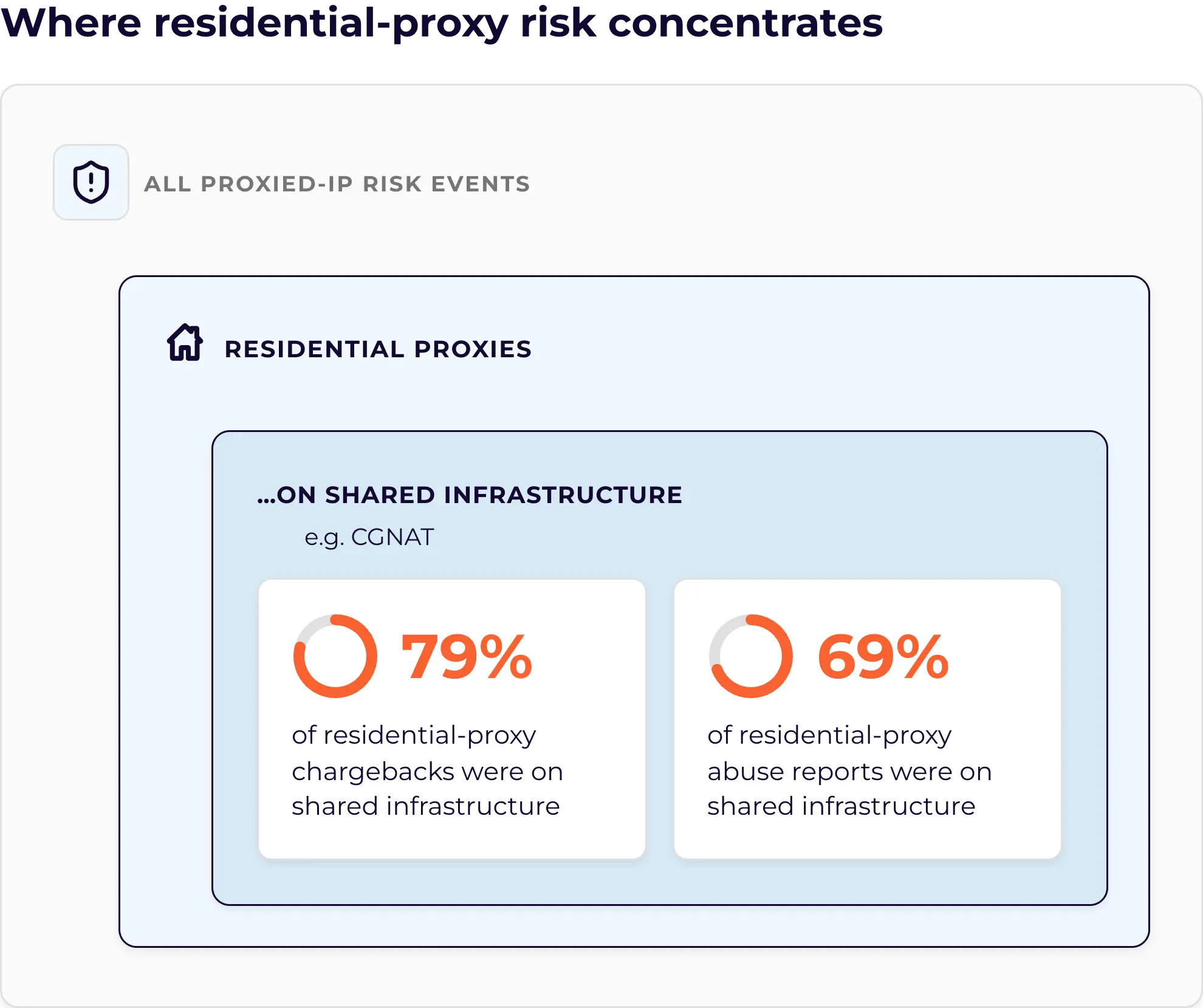
Because of this, blocking all residential proxies risks disrupting a vast amount of legitimate user activity.
A targeted approach to residential proxy detection and blocking
MaxMind’s residential proxy and VPN probing gives businesses industry-leading coverage for critical use cases where downloadable databases are essential. But the data alone is not enough; the application of that data is what matters.
Instead of a binary “block or allow” decision, businesses can use confidence scores to protect against fraud while maintaining a seamless experience for their legitimate users. Here’s how we recommend using MaxMind data, based on your use case:
For regulatory and legal compliance: Consider adding additional verification steps for transactions with low-to-medium confidence scores. This reduces friction and cost of verifying every transaction but identifies the most concerning ones.
For real-time decisioning in high-risk use cases: When you need deeper intelligence, prioritize multi-attribute transaction risk scoring services like minFraud. These services are aware of residential proxy networks but incorporate behavioral, device, email, and other signals to distinguish between a fraudulent user and a legitimate one on a proxied connection.
For firewalls: Be cautious. While you can block VPNs identified through active probing with high confidence, treat residential proxies as a nuanced signal. You might consider blocking only very high-confidence residential proxies (i.e., anonymizer confidence scores of 88/100 or higher).
For ad fraud: Experiment with different threshold levels to balance blocking effectiveness against the impact on legitimate ad reach.
These are general starting points and the right approach depends on your specific business. MaxMind’s product experts can work with your technical and risk teams to help understand your specific challenges and apply our proxy data effectively for your applications. Reach out today to talk about how to balance security and usability for your business.